
The metal behind stronger steel: niobium’s concentrated supply
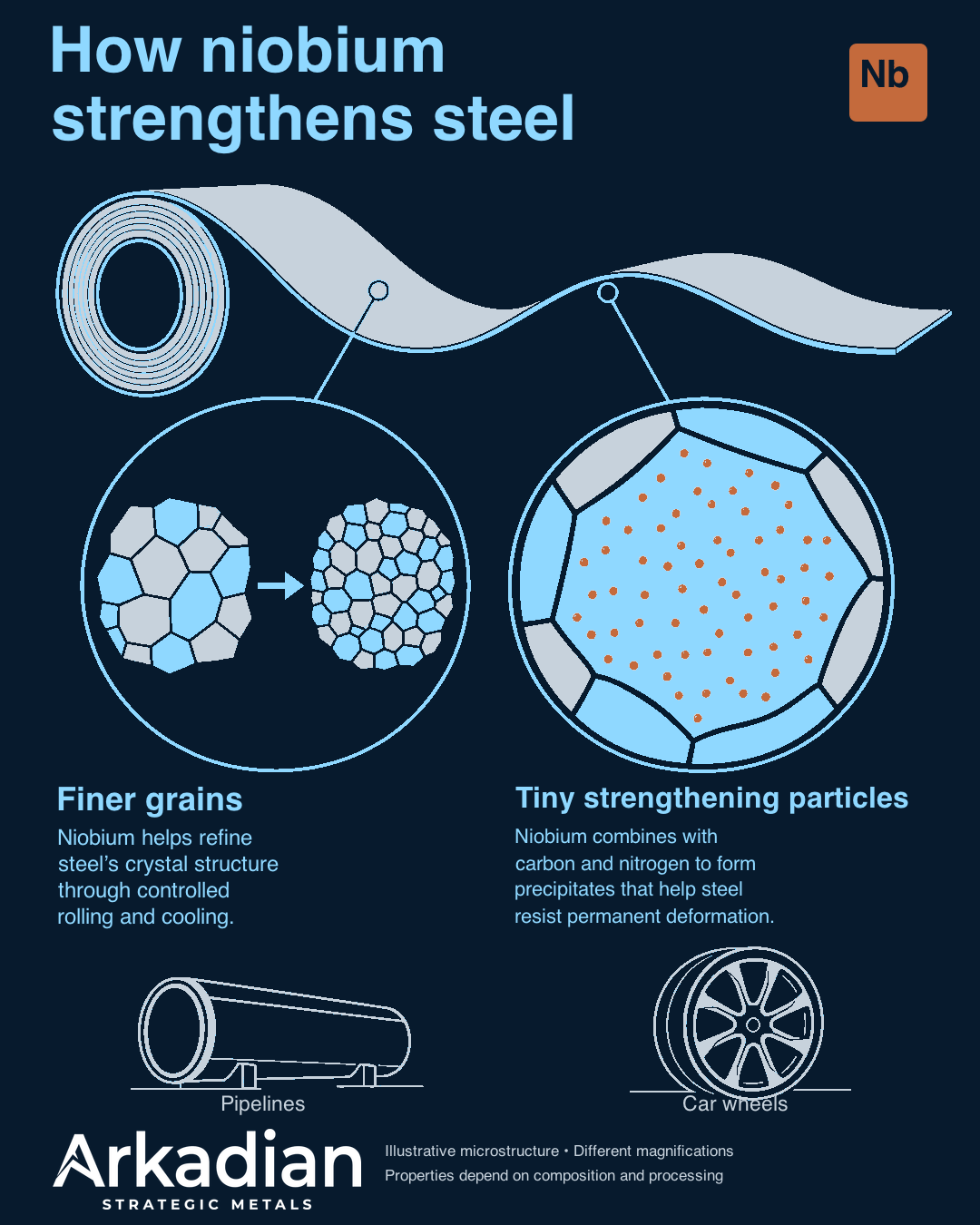
A small addition of niobium can help make steel stronger. Its effect begins inside the metal, where tiny crystals called grains form a microscopic mosaic.
During controlled rolling and cooling, niobium helps develop a finer grain structure. It also combines with carbon and nitrogen to form tiny particles, called precipitates, which help steel resist permanent deformation.
These processes help strengthen steels used in pipelines and car wheels. How much stronger the steel becomes depends on its composition and the way it is rolled and cooled.
For a metal with such an important role in steelmaking, niobium’s production is remarkably concentrated. USGS estimates that Brazil produced about 93% of the world’s mined niobium in 2025, with Canada contributing around 5%. Together, two countries accounted for roughly 98% of global mine production, leaving few producing alternatives.
That concentration gives a practical reason to investigate additional sources. At Motzfeldt’s Aries area in southern Greenland, the JORC-compliant, multi-element Inferred Mineral Resource reported in 2012 is 340 million tonnes, including an estimated 629,000 tonnes of contained niobium pentoxide (Nb₂O₅).
Published mineralogical work at Aries has already identified niobium-bearing minerals including pyrochlore and columbite. Those findings give Arkadian a starting point for testing concentration methods and assessing Motzfeldt’s potential as an additional source of niobium.
#ArkadianStrategicMetals #Motzfeldt #Niobium