
Dr Curtis Rooks on Mineralogy and Targeting at Clogau
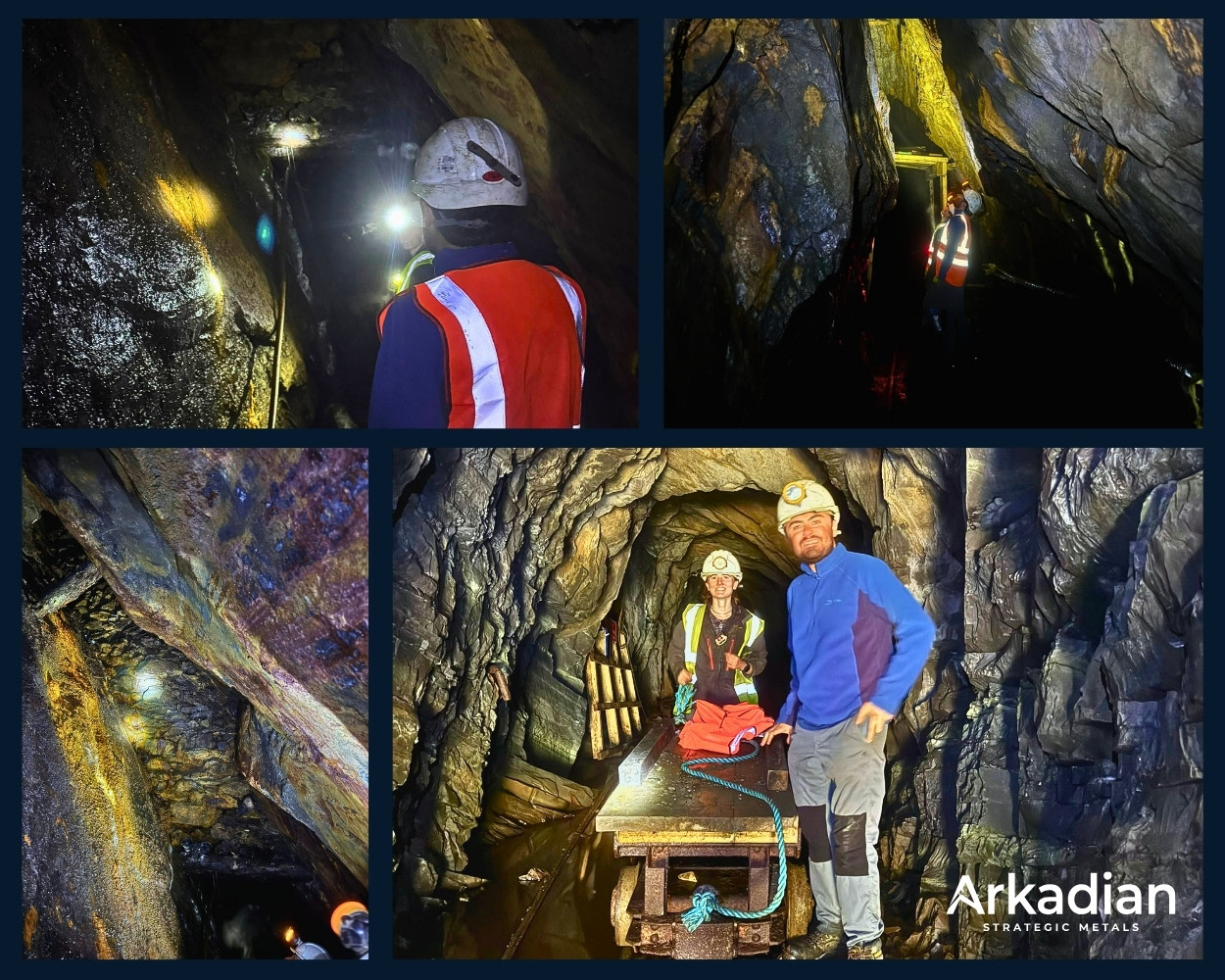
Arkadian’s recent underground development has opened a fresh geological window at the Clogau-St David’s Gold Mine. In this Q&A, Arkadian’s Principal Geologist Dr Curtis Rooks explains how mapping, sampling and mineralogy are being combined with historic mine knowledge to refine targets and guide the next phase of underground work.
Hello, Dr Rooks. Thank you for speaking with me about the mineralogical work now under way at the Clogau-St David’s Gold Mine.
What can mineralogy tell us that an assay cannot?
An assay tells us how much gold is present. Mineralogy shows where the gold sits in the rock, what form it takes and which geological features occur around it.
At Clogau, we are looking at relationships between gold, quartz textures, fractures, host rocks and sulphides such as pyrite, arsenopyrite, galena and sphalerite. This helps us recognise the geological settings most closely associated with mineralisation elsewhere in the mine.
Why is this detailed mineralogical review being undertaken now?
The recent Level 5 development has provided a fresh, continuous exposure through the Lower Llechfraith area. We can now examine the geology directly, collect accurately located samples and compare the exposed ground with historic plans and workings.
This gives us new physical evidence to assess the structure and determine where the next phase of underground work can add the greatest geological value.
How did historic miners find gold without modern analytical equipment?
They relied on close observation and practical experience. Over time, they learnt which vein structures, rock types and fractures were most often associated with gold and followed those features underground.
Their workings provide an important record of where they followed a structure, changed direction or stopped. Examining those decisions can help us understand which geological relationships proved most useful to them.
What were the practical “rules” followed by historic miners?
These were observations about where a vein or branch appeared on the rock face, the direction in which it was running and how it behaved when it split or intersected another structure.
Through experience, miners recognised patterns that helped them decide whether to follow a vein to the left, to the right or continue ahead. We can now assess which of those observations have a sound geological basis and may remain useful for targeting.
Why can Arkadian not simply repeat the methods used by the historic miners?
The historic miners followed the most visible and accessible mineralised structures, selectively working richer pockets and moving on when grades declined. Many of the most obvious high-grade areas have therefore already been mined.
At the same time, the mine was not explored or developed systematically, leaving less understood ground between, beneath and beyond the historic workings. Modern mapping, mineralogy and three-dimensional mine plans allow us to investigate those less obvious areas more systematically.
We also work within modern environmental, ecological, planning and safety requirements. Development must therefore be carefully targeted and supported by geological evidence. This makes the current review an important step in selecting the strongest case for future underground work.
How does sampling support the mineralogical review?
Each sample is recorded with its precise location, host rock, vein orientation, quartz texture and sulphide content, supported by photographs and field observations.
Where appropriate, material can be retained for further work, including thin-section analysis or reflected-light microscopy. This creates a consistent dataset that allows geological features to be compared across different parts of the mine.
Is the current review limited to the new Level 5 development?
No. Level 5 provides an important new exposure, but the review covers the wider mine. We are comparing it with Levels 4 and 4.5, historic plans, known gold occurrences and other accessible workings.
This will help us understand how the main vein corridors, branches and host-rock contacts connect across the mine and identify where further work could add the most value.
How do the recently completed bat surveys support the wider review?
The surveys provide updated ecological information for parts of the mine that may become relevant to future work.
This allows exploration priorities to be considered alongside environmental requirements, permissions, ground conditions and safe access from an early stage. It supports a structured and responsible approach to planning the next phase of in-mine exploration.
How does the ‘nuggety’ nature of Clogau gold affect exploration and sampling?
Gold at Clogau can be concentrated in small pockets or along particular boundaries within a vein. A sample may therefore accurately represent one location without representing the wider structure.
We address this through closely spaced sampling, appropriate sample sizes and detailed recording of the vein geology. Drilling can help locate the wider vein corridor and key structures, while underground mapping and sampling provide the detail needed to understand local gold distribution.
What would a useful outcome from the mineralogical programme look like?
The objective is a practical set of mineralogical criteria for recognising favourable ground. We want to establish which combinations of structure, host rock, quartz texture and mineral association occur most consistently in known gold-bearing settings.
This would allow the team to rank targets and design future sampling, access or development around specific geological objectives.
What are the next practical steps?
The immediate priorities are to complete the current mapping and sampling, receive the assay results and assess them alongside the mineralogical observations. Selected material may then undergo thin-section, reflected-light or more detailed analysis where this can answer a specific geological question.
The results will be used to rank potential targets and determine where further sampling, access or development may be most effective. Any material findings will be communicated through the appropriate regulatory channel once the technical review is complete.
Thank you, Dr Rooks.
Share your feedback
Discover